Intercellular
communication.
Introduction
MUSE Exosomes, also known as Muse-Exos, are extracellular vesicles derived from multilineage-differentiating stress-enduring cells. Like other exosomes, they carry biological cargo such as proteins, lipids, nucleic acids, and microRNAs between cells. What makes MUSE Exosomes distinct is their specialized source-cell profile, which is being studied for stress-response signaling, regenerative biology, oxidative-stress modulation, and tissue microenvironment support. Because the biological activity of extracellular vesicles depends strongly on the source cell and verified cargo composition, MUSE cell-derived exosomes should be presented as a specialized research platform rather than a generic exosome product.
What Are MUSE Exosomes?
MUSE Exosomes are a specialized class of extracellular vesicles derived from MUSE cells — multilineage-differentiating stress-enduring cells. They are being investigated for their role in cellular communication, stress-adaptive signaling, immunomodulatory signaling, and tissue-support research. Product identity should be confirmed through validated characterization, including particle size, concentration, purity, sterility, endotoxin level, and exosomal marker profile.
Cell-to-Cell Communication
MUSE Exosomes are nanoscale vesicles designed to transfer biological signals between cells. Their cargo may include proteins, lipids, RNA, and microRNAs that interact with target cells through receptor binding, uptake, or membrane fusion. Research focuses on how these signals may influence cellular stress response, inflammatory pathways, and regenerative microenvironments.
Research Positioning
MUSE Exosomes should be positioned as an advanced extracellular-vesicle research platform. Current scientific interest focuses on regenerative signaling, oxidative-stress response, inflammatory signaling, skin and tissue-support research, hair follicle microenvironment research, and drug-delivery or biomarker applications. They should not be presented as an approved treatment, cure, or replacement for medical care.
Laboratory
Samples.

Specification
- Particle size by NTA: 130±40 nm
- Purity: ≥ 97 %
- Identity: Complies
- Sterility: Sterile
- Endotoxin level: <10 EU/mg
- DNA/RNA concentration: > 400 ng/mL
- Protein concentration: > 800 µg/mL
- Exosomal markers: CD9 / CD63 / CD81
- Additional EV markers: TSG101 / ALIX
- Source-cell verification: MUSE / SSEA-3-positive [source verification required]
Lot Result
- Particle size by NTA: 125 nm
- Purity: ≥ 99,5 %
- Identity: Complies
- Sterility: Complies
- Endotoxin level: <2.3 EU/mg
- DNA/RNA concentration: >1876 ng/mL
- Protein concentration: > 1800 µg/mL
- Exosomal markers: Verified
- Additional EV markers: Verified
- Source-cell verification: MUSE / SSEA-3-positive
Formulation
0.22 µm-filtered solution containing:
- — 20 mM glycine,
- — 100 mM Trehalose,
- — 200 mM Mannitol,
- — 20 mM NaH2PO4 (pH 7.4);
As lyophilized powder.
Exosome count per vial:
100±10 billion per mL
Purity and identity was determined by Nanosight LM10 measurements. Protein was measured using Lowry standardized assay, DNA/RNA concentration was measured using standardized Qbit analysis assay. Sterility test of vialed product was performed according to Eur.Pharm. (Inoculation method). Endotoxin was determined using the gel clot assay according to Eur.Pharm.
Research
Areas.
MUSE Exosomes are being investigated across multiple research areas because of their role in cell-to-cell communication and stress-response signaling. The applications below describe investigational research directions only and should not be interpreted as approved clinical uses.
Origin & Mechanism
MUSE Exosomes are extracellular vesicles derived from multilineage-differentiating stress-enduring cells. Their biological cargo may include proteins, lipids, nucleic acids, and microRNAs that support intercellular signaling. Research interest focuses on oxidative-stress response, anti-apoptotic signaling, immunomodulatory signaling, and tissue microenvironment support. Final claims must be based on verified source-cell identity, cargo characterization, and lot-specific quality data.
Investigational Applications
MUSE Exosomes are being studied for potential roles in regenerative biology, inflammatory signaling, cellular stress response, skin and tissue-support research, and advanced extracellular-vesicle delivery systems. These applications remain investigational unless reviewed and approved by the relevant regulatory authority.

MUSE Exosome Research Areas
MUSE Exosomes are being studied for their role in cellular communication, oxidative-stress balance, and tissue microenvironment support. Research may explore how Muse-Exos influence collagen-related signaling, cellular repair pathways, and skin biology.
MUSE cell-derived exosomes are being investigated for their potential influence on inflammatory and immune-signaling pathways. This research does not imply treatment of autoimmune disease and should be described only as investigational biology.
Extracellular vesicles are widely researched as delivery systems and biomarker platforms. MUSE Exosomes may be explored for cargo delivery, target-cell interaction, and diagnostic research, depending on verified composition and manufacturing controls.
Research into MUSE Exosomes may examine how their biological cargo interacts with inflammatory pathways, oxidative stress, and tissue microenvironments. Do not claim treatment of Lyme disease or chronic inflammatory disease.
MUSE Exosomes may be studied for their effects on scalp and follicle microenvironment signaling, angiogenesis-related pathways, and regenerative communication. Do not claim guaranteed hair regrowth.
MUSE Exosomes are being explored as part of advanced regenerative biology research because of their role in intercellular communication, stress-response signaling, and tissue-support mechanisms.
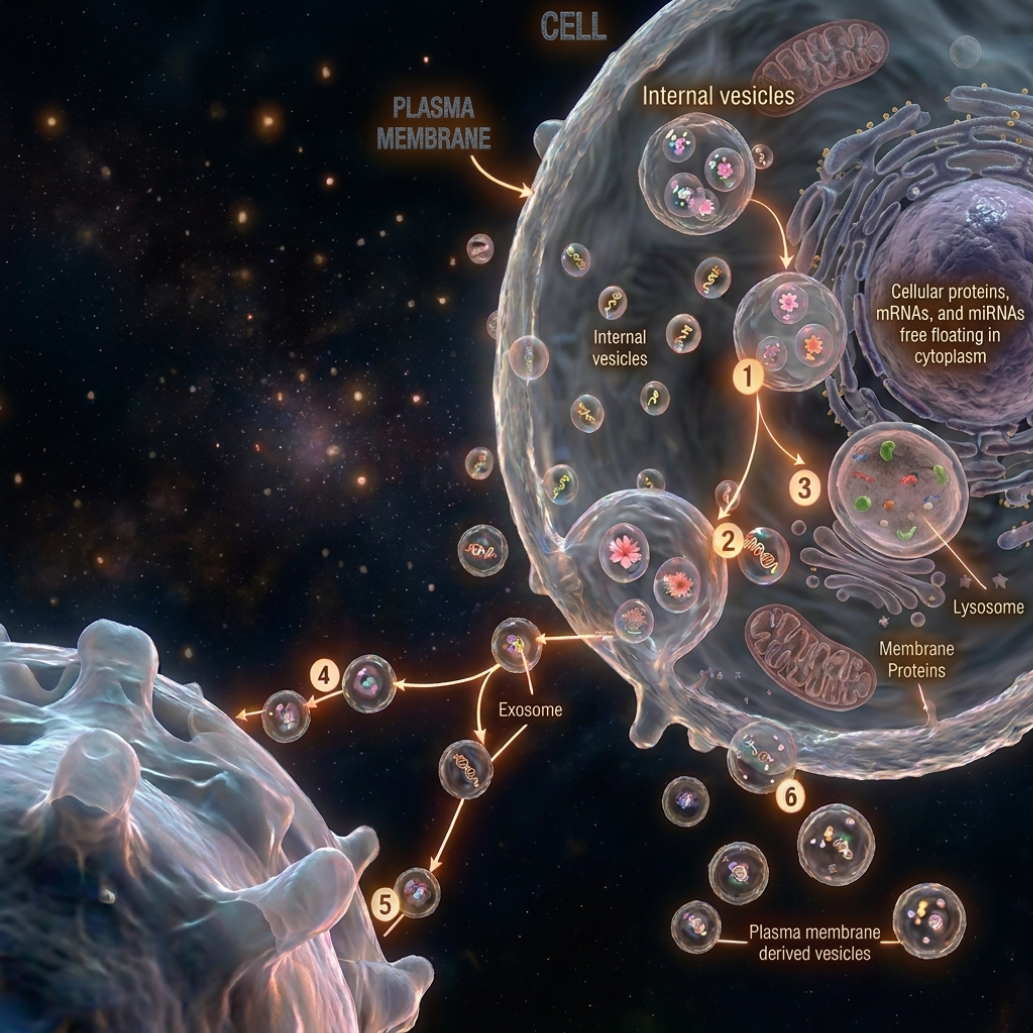
FROM FORMATION
TO TARGET.
Vesicle Release
01These internal vesicles are released as extracellular vesicles when MVE fuse with the cell membrane.
Lysosomal Fusion
02Alternatively, MVE can fuse with lysosomes, which degrade MVE contents.
Target Recognition
03Upon reaching their destinations, usually determined by the binding of specific ligands on their surfaces, vesicles can enter target cells in one of two ways: by being taken up by the target cell's endocytic pathway.
Membrane Fusion
04Or by fusing to the target cell's membrane and releasing its contents directly into the cytoplasm.
Vesicle Secretion
05Cells also secrete other membrane-derived vesicles, such as ectosomes, shed vesicles, or macrovesicles, which bud directly from the cell's plasma membrane.
Active Transport
06These vesicles are also known to carry active proteins and RNAs, as well as some compounds specific to the source-cell profile, but little is known about their effects on distant tissues.

Research Handling
Guidelines.
For research or investigational use, handle lyophilized MUSE Exosome material according to the validated manufacturer protocol, local biosafety requirements, and applicable regulatory guidance. Reconstitution, storage, and application procedures must be performed only by qualified personnel under approved protocols.
Long Term Storage
Storage at -20°C or below is recommended unless the certificate of analysis or manufacturer protocol states otherwise.
Short Term Storage
For transportation, lyophilized product may be stored at +2°C to +8°C according to validated shipping conditions.
Liquid Exosomes
After reconstitution, use according to the validated protocol. Do not freeze unless the manufacturer’s stability data confirms compatibility.
Protocol Use
Administration, dosing, and route of use must not be displayed unless approved by medical, regulatory, and legal review.
Pricing
Tiers.
Starter Research Kit
Ideal for initial in vitro assay validation and sizing studies.
- 5 Lyophilized Vials (100bn particles/vial)
- Standard characterization report (NTA)
- Sterility & endotoxin validation data
- Basic reconstitution buffer included
- Full product specification documentation
Standard Evaluation Pack
Optimized for cellular pathway and dose-response modeling.
- 10 Lyophilized Vials (100bn particles/vial)
- Lot-specific Certificate of Analysis (COA)
- Full marker profiling (CD9/CD63/CD81/TSG101)
- Sterile reconstitution buffer kit
- Priority technical research support
Advanced Research Kit
Complete set for high-throughput screening and in vivo models.
- 15 Lyophilized Vials (100bn particles/vial)
- Full lot-specific COA & characterization
- Certified SSEA-3 positive cell source validation
- Complete buffer & preparation kit
- Direct consultation with research scientists